Psychologist or behaviour support practitioner: what's the difference?
Psychologists and NDIS behaviour support practitioners do different jobs. Here is how they differ, and what it means when one person is both.
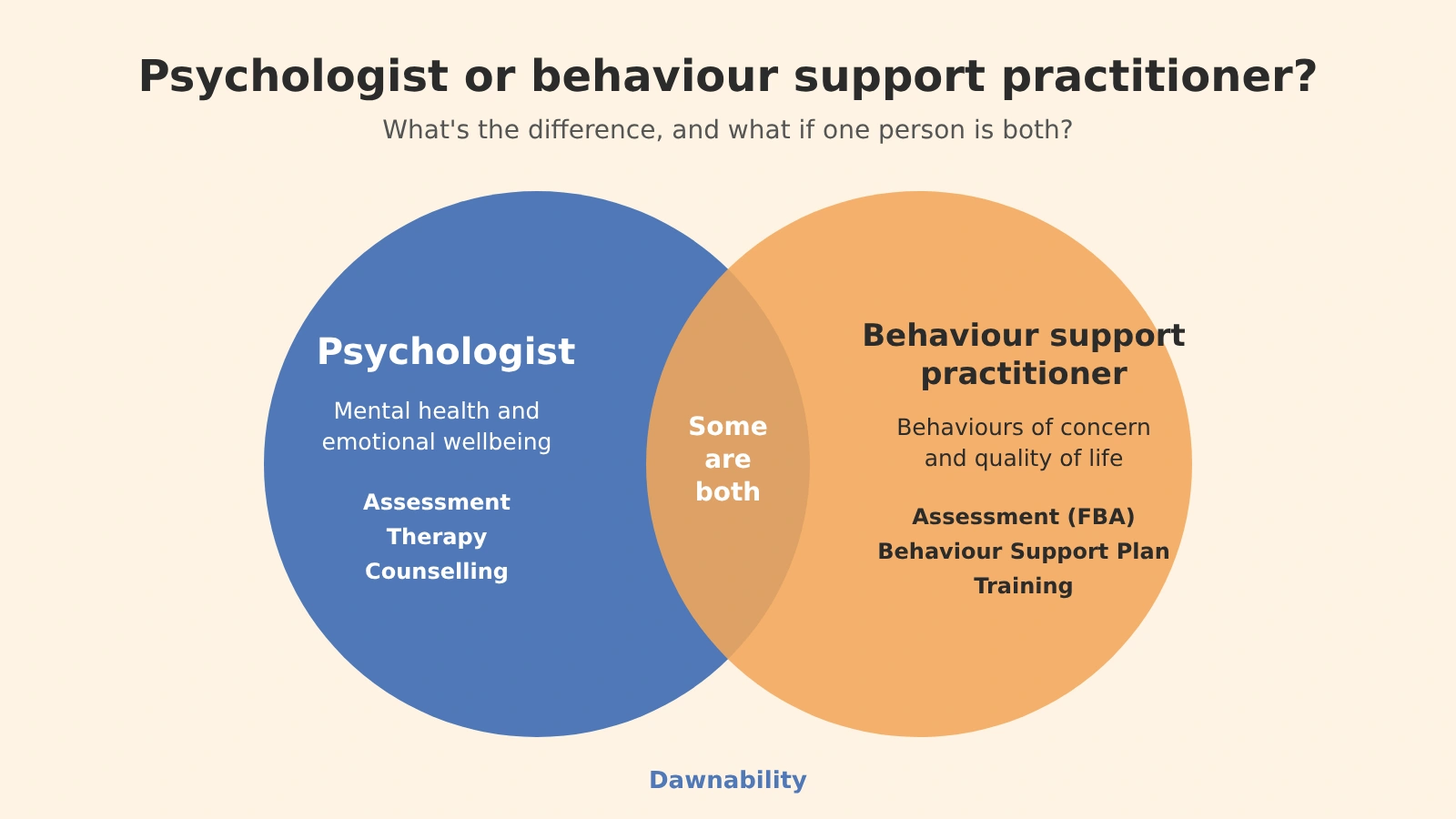
Families are often told their family member needs "a psychologist" or "behaviour support" as though the two were the same thing. They are not, although they overlap, and the same person can sometimes be both.
Knowing the difference helps you ask for the right support and use the right part of an NDIS plan.
What a psychologist does
A psychologist is a registered health professional. In Australia, "psychologist" is a protected title. To practice and to use the title, a person must be registered with the Psychology Board of Australia, and their qualifications must be accredited and approved by the Board.
Psychologists assess and treat mental health and emotional wellbeing. At Dawnability, our registered psychologists provide psychological assessment, therapy and counselling for children, young people, adults, and older adults.
The work is usually centred on the person: their thoughts, feelings, experiences and coping skills.
What a behaviour support practitioner does
A behaviour support practitioner is a role defined under the NDIS. It is not a health profession in its own right. A practitioner is a person the NDIS Quality and Safeguards Commission has considered suitable to carry out behaviour support assessments and develop Behaviour Support Plans. Suitability is assessed against the Commission's Positive Behaviour Support Capability Framework.
Because the role is defined by suitability and not by profession, a behaviour support practitioner may or may not be a psychologist.
Behaviour support practitioners work on behaviours of concern. They carry out Functional Behaviour Assessments, write Behaviour Support Plans, train families and support workers, and work to reduce restrictive practices.
The work is centred on the person in their surroundings. A good deal of it involves the people and places around the person, not only the person themselves.
Side by side
Psychologist
Main focus: mental health and emotional wellbeing
Works mostly with: the person
Typical work: psychological assessment, therapy, counselling
Who oversees them: Psychology Board of Australia, supported by Ahpra
Who can use them: NDIS participants and private clients
NDIS budget, generally: Improved Daily Living
Behaviour support practitioner
Main focus: behaviours of concern and quality of life
Works mostly with: the person, their family and their support team
Typical work: Functional Behaviour Assessment, Behaviour Support Plan, training
Who oversees them: NDIS Quality and Safeguards Commission
Who can use them: NDIS participants
NDIS budget, generally: Improved Relationships
Funding depends on what is written in the individual plan, so check yours or ask your support coordinator.
When your behaviour support practitioner is also a psychologist
Some practitioners hold both roles. They are registered psychologists who have also been considered suitable by the NDIS Commission to provide behaviour support. Psychology registration alone is not enough for the second part. The Commission requires anyone providing behaviour support under the NDIS to apply and be considered suitable.
What this can bring:
Clinical training alongside behaviour support skills. A psychologist is trained in psychological assessment and mental health, which can inform how they understand a behaviour.
Attention to what sits underneath. Anxiety, low mood or past trauma can be part of why a behaviour happens. A practitioner with psychology training is equipped to recognise this and to recommend the right follow-up.
Two sets of professional obligations. They answer to the Psychology Board for their conduct as a psychologist and to the NDIS Commission for their behaviour support work.
What it does not change:
The two services stay separate. Behaviour support is not therapy. If your practitioner is engaged for behaviour support, their job is the assessment, the plan and the training, not weekly counselling.
You may still need both. Some people benefit from behaviour support and psychological therapy at the same time. These may be delivered by the same clinician or by two different people.
The funding is usually separate. Each service generally draws on a different part of an NDIS plan.
If you are unsure, ask your practitioner directly: "Which role are you working in with us, and what is it funded from?"
Which one do we need?
As a rough guide:
If the main concern is how a person is feeling or coping, such as anxiety, low mood or grief, a psychologist is usually the starting point.
If the main concern is a behaviour that puts the person or others at risk, or that is limiting their daily life, behaviour support is usually the starting point.
If it is both, or you cannot tell, that is common. An initial conversation can help work out where to begin.
How Dawnability works
Dawnability is a psychologist-led practice. Many of our behaviour support practitioners are also registered psychologists. They work in the same team as the psychologists who provide assessment and therapy, so the two services can be coordinated when a person needs both.
We support children, young people and adults across Canterbury-Bankstown, South-West Sydney and Greater Western Sydney, and across Australia, with English and Arabic-speaking staff available. To talk about what would suit your family member, contact us through the enquiry form on our website.