Restrictive practices explained for families and carers
A plain-English guide to restrictive practices under the NDIS: what they are, the safeguards that protect your family member, and what you can ask.
Oct 12, 2026
Positive Behaviour Support Practice (BSP)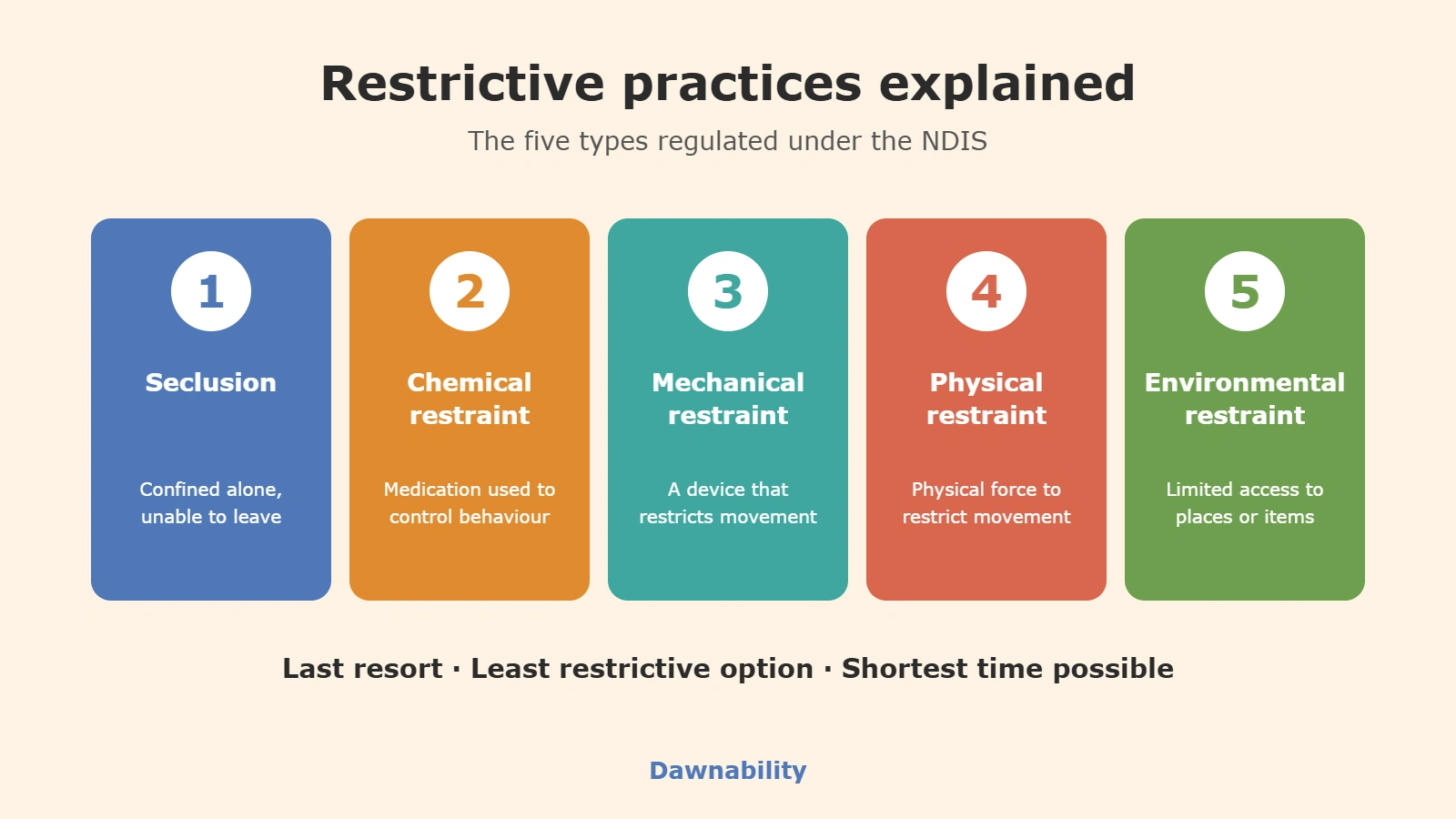
If you have heard the term "restrictive practice" in a meeting, or seen it in a Behaviour Support Plan, it is natural to have questions. Restrictive practices are tightly regulated, and the aim across the NDIS is to use them less and, wherever possible, not at all.
This short guide explains what the term means and the safeguards that protect your family member. It is general information, not legal advice.
What it means
A restrictive practice is anything that limits some of the person's rights or freedom of movement. NDIS providers can only use one in response to a risk of harm to the person or to others. NSW guidance is clear that it should never be used as punishment or for staff convenience.
The five types
The NDIS regulates five types:
Seclusion: Keeping a person alone in a space they cannot freely leave. NSW guidance states this is prohibited for anyone under 18.
Chemical restraint: Medication used mainly to influence behaviour. Medication prescribed to treat a diagnosed condition is not included.
Mechanical restraint: A device used to limit movement in order to influence behaviour. Devices used for therapeutic purposes are not included.
Physical restraint: Physically limiting a person's movement to influence behaviour. Reflexively guiding someone away from harm, as part of everyday care, is not included.
Environmental restraint: Limiting access to places, items or activities, such as a lock on the fridge.
Some of these, like a locked fridge, can look ordinary. They are still covered by the rules when an NDIS provider/worker uses them.
The safeguards that protect your family member
A provider can only use a regulated restrictive practice if it is:
A last resort, after proactive and person-centred strategies have been tried
The least restrictive option available
Used for the shortest time possible
Clearly written into a Behaviour Support Plan.
In NSW, it must also be authorised by a Restrictive Practices Authorisation Panel, and authorisation is not valid without appropriate consent. The person should be invited to the panel meeting, and family members are encouraged to attend. Plans that include a restrictive practice are reviewed at least every 6 months and should set out how the practice will be reduced and stopped.
Questions you can ask
What has already been tried?
Why is this the least restrictive option?
What is the plan to reduce and stop it?
When is the panel meeting, and can we attend?
If you have concerns
Start by talking with your provider.
Our approach at Dawnability
Our focus is on proactive, positive and least-restrictive strategies that reduce and eliminate the need for restrictive practices. They are considered only where there is a serious and immediate risk of harm, in line with NDIS legislation and guidelines, and with ongoing monitoring and review.
If this has been raised for your family member and you would like to talk it through, contact us through the enquiry form on our website. English and Arabic-speaking staff are available.